EMF Meters and Geiger Counters: What K2, ET925, EMF01 and GC-03 Really Measure
This page contains affiliate links. We may earn a commission at no extra cost to you.
On this page
Handheld EMF meters and Geiger counters are inexpensive, fun to use and widely misunderstood. They measure very different things, and the numbers on the screen only mean something when you know what the sensor detects, what frequency range it covers and what a normal reading looks like. This guide explains what popular budget models measure and where they are genuinely useful, without the scare stories that often surround them.
Two very different kinds of "radiation"
The word "radiation" covers two separate things that these devices detect:
- Non-ionizing electromagnetic fields (EMF): the electric and magnetic fields around mains wiring and appliances (50 or 60 Hz and harmonics), and radio-frequency signals from Wi-Fi, phones and broadcast transmitters. EMF meters measure these.
- Ionizing radiation: higher-energy particles and photons (alpha, beta, gamma and X-rays) from radioactive materials and cosmic rays. Geiger counters detect this.
An EMF meter cannot detect radioactivity, and a Geiger counter cannot measure Wi-Fi or mains fields. Buy the tool that matches the question you are asking.
What EMF meters measure
Budget EMF meters usually measure one or more of these:
- Low-frequency magnetic field, shown in microtesla (uT) or milligauss (mG); 1 uT equals 10 mG. Sources include transformers, motors, power cables carrying current and induction hobs. Magnetic fields fall off quickly with distance.
- Low-frequency electric field, shown in volts per meter (V/m). It comes from wiring and devices that are plugged in, even when switched off. Electric field readings are easily affected by how you hold the meter and by nearby objects.
- Radio-frequency (RF) field, shown in V/m, uW/m2 or mW/m2. Cheaper meters that list RF usually have a limited frequency range and broad accuracy.
Read the specification for the frequency range of each sensor. A meter designed for 50/60 Hz fields will not respond meaningfully to a 2.4 GHz Wi-Fi router, and an RF meter will not show the field from a mains transformer.
K2-style 5-LED meters
The K2 design is a simple meter with a row of five colored LEDs rather than a numeric display. It responds to low-frequency magnetic fields, with each LED representing a range of field strength. It is popular in paranormal investigation shows, which is why it is so widely sold.
Realistic uses: finding live cables in a wall before drilling, locating a noisy transformer or motor, checking whether an appliance is drawing current, or demonstrating how magnetic fields fade with distance in a classroom. Because there is no number, it is a "more or less" indicator, not a measuring instrument. A sudden flash near a phone is usually the phone's own electronics or a nearby cable, not anything mysterious.
ET925 and MESTEK EMF01: numeric handheld meters
Meters such as the ET925 and the MESTEK EMF01 have a digital display and typically show both electric field (V/m) and magnetic field (uT) readings, with sound alarms when a threshold is exceeded. Check each listing for the exact frequency range and whether an RF function is included, as specifications differ between models and versions.
Numeric meters are more useful than LED meters because you can compare readings, for example:
- Seeing how quickly the magnetic field drops when you move a meter a foot away from a power adapter.
- Finding which socket or extension lead has a faulty or unearthed device.
- Locating hidden wiring routes or confirming a circuit is de-energized (as a rough check only; always use a proper voltage tester for electrical work).
- Diagnosing hum in audio equipment caused by a nearby transformer.
Treat the absolute numbers with caution. Budget meters are not calibrated instruments, and two meters can disagree by a large margin. They are best for relative comparisons: higher here, lower there.
What the numbers do and do not mean
National and international bodies publish exposure guidelines for EMF, and everyday household levels are typically well below them. A high reading right next to an appliance is normal, because fields are strongest at the source and drop sharply with distance. A budget meter cannot tell you whether something is "safe" or "unsafe"; it can only tell you where fields are stronger or weaker. If you have a genuine concern, for example about wiring faults, ask a qualified electrician.
Geiger counters and the GC-03
A Geiger counter uses a gas-filled Geiger-Muller tube. When ionizing radiation passes through the tube, it causes a brief pulse that the electronics count, usually with a click. The display shows counts per minute (CPM) and an estimated dose rate in microsieverts per hour (uSv/h).
Compact devices like the GC-03 are designed as personal radiation monitors with a dose alarm. Most budget tubes respond mainly to gamma and higher-energy beta radiation; few detect alpha particles, which are stopped by the tube wall. Check the listing for the tube type and the radiation types it claims to detect.
Background levels
You will never see zero. Natural background radiation comes from cosmic rays, radon and the minerals in rocks and building materials, and it varies with location, altitude and geology. Typical readings on budget counters are often somewhere around 0.05 to 0.3 uSv/h, but your local background may differ. The first thing to do with a new counter is to record readings at home and outdoors over a few days, so you know what normal looks like for you.
Realistic uses
- Learning about natural radioactivity and how readings change on a flight or at higher altitude.
- Checking antiques such as uranium glass, old luminous watch dials or some vintage ceramics, which can read above background.
- Comparing building materials such as granite worktops (usually only slightly above background).
- Science demonstrations of how distance and shielding reduce counts.
A budget Geiger counter is an educational and hobby tool, not a certified dosimeter. Do not rely on it for occupational safety or emergency decisions. Do not open or handle radioactive items such as old radium dials, and follow official guidance in any real radiation incident.
Buying tips
- Decide what you want to measure first: mains fields, RF, or ionizing radiation.
- Check frequency ranges, units and whether the meter shows numbers or just lights.
- Look for a data hold or max function if you want to compare readings.
- For Geiger counters, check the tube type, the displayed units and battery life.
These meters ship from marketplace sellers, often within one to three weeks. Check seller ratings and return terms before ordering. If you enjoy exploring invisible signals, our first SDR buying guide shows how to see the radio spectrum itself, and our monoculars guide covers optics for fieldwork.
Listings to consider

K2-style 5-LED EMF meter
Quick field checksA simple meter with five colored LEDs that respond to low-frequency magnetic fields. It is handy for finding live cables, transformers and motors, and for classroom demonstrations. It gives no numeric reading, so it is an indicator rather than a measuring instrument, and it will not respond to Wi-Fi or other RF signals.
Listing: K2-style 5-LED EMF meter

ET925 EMF tester
Household checksA portable digital EMF tester aimed at household appliances, typically showing electric and magnetic field readings with an alarm. It suits anyone who wants numbers to compare from one spot to another. Readings are best treated as relative, not calibrated, and you should check the listing for the exact frequency ranges covered.
Listing: ET925 Portable Electromagnetic Radiation Tester EMF Meter Household Appliances Mobile Ele…

MESTEK EMF01 detector
Numeric readingsA handheld EMF detector from MESTEK with a digital display, designed for checking fields around wiring and appliances. It is a step up from LED-only meters if you want to log or compare values. Confirm which field types and frequency ranges it measures in the listing, as budget meters differ widely.
Listing: MESTEK EMF01 EMF radiation detector
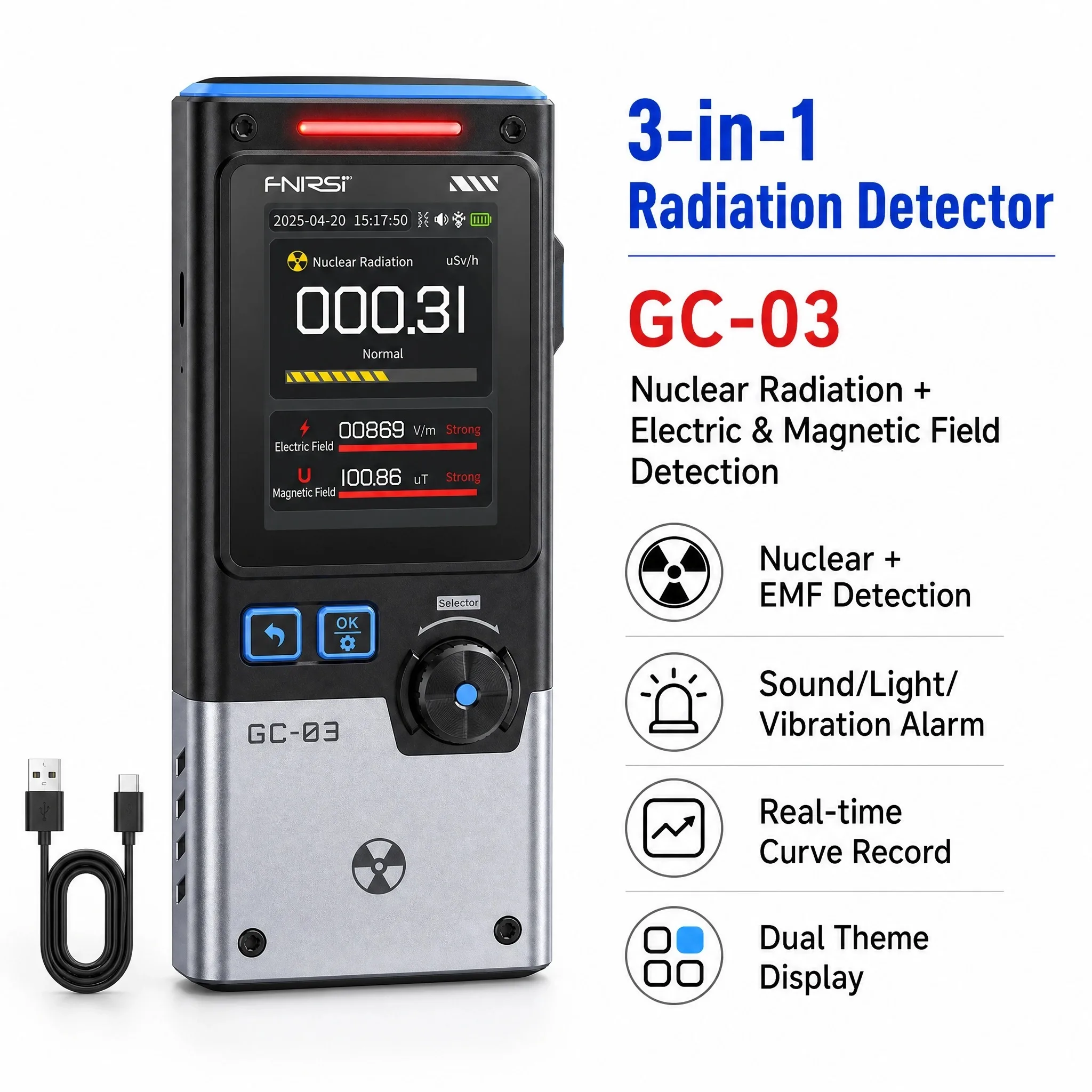
GC-03 Geiger counter
Radiation hobbyistsA compact Geiger counter with a dose alarm that detects ionizing radiation and shows counts and an estimated dose rate. It suits hobbyists checking uranium glass, learning about background radiation or taking readings on trips. Record your normal background first, and remember it is not a certified dosimeter for safety decisions.
Listing: GC‑03 Geiger Counter Nuclear Radiation Detector Professional Personal Dose Alarm Device R…